

Last updated November 2026
Definitions & Concepts
What Is Ciguatera?
Ciguatera is a foodborne poisoning from eating tropical or subtropical reef fish that have accumulated ciguatoxins, heat-stable toxins made by marine microalgae. It causes GI illness within hours of the meal, followed by neurologic symptoms that can last weeks to months. It accounts for close to half of reported fish-borne poisonings in the US.
- Typical story: reef fish dinner → vomiting and diarrhea within hours → perioral tingling, paresthesias, cold that feels like burning
- No test, no antidote: diagnosis is clinical and treatment is supportive
Ciguatera is a clinical diagnosis: GI symptoms after a reef fish meal, then neurologic symptoms. Clusters of people who ate the same fish clinch it.
Epidemiology
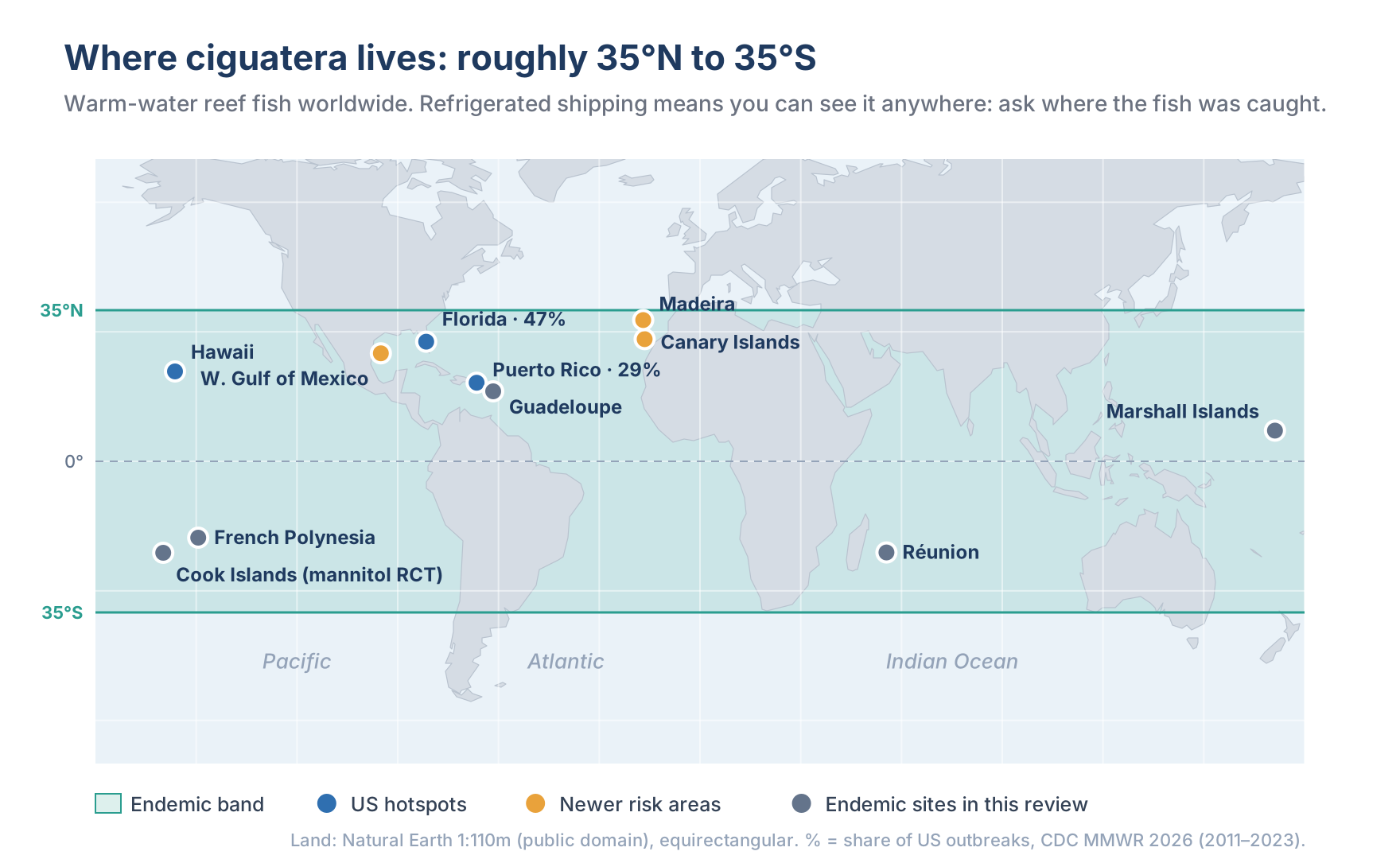
- Endemic in warm-water reef fish between roughly 35° N and 35° S: the Caribbean, South Pacific and Indian Ocean.
- In the US, most outbreaks come from Florida (47%) and Puerto Rico (29%), plus Hawaii. Barracuda, grouper and amberjack are the most common culprits, usually prepared at home (CDC MMWR 2026).
- Cases peak in the warmer months, and range is expanding with warming oceans and the global fish trade. Newer risk areas include Madeira, the Canary Islands and the western Gulf of Mexico.
- Massively under-reported: worldwide estimates run from 10,000 to 500,000 cases a year. Travelers to highly endemic areas may have an incidence as high as 3 per 100.
Refrigerated shipping means you can see ciguatera far from the tropics. Ask where the fish was caught, not just where it was eaten.
Where the Toxin Comes From
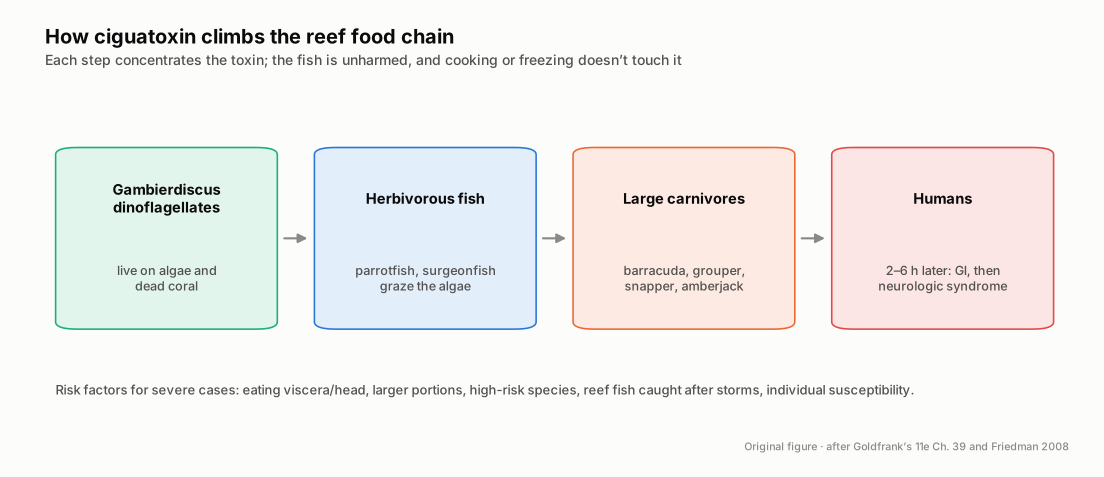
- Benthic dinoflagellates (Gambierdiscus, Fukuyoa) living on algae and dead coral produce precursor toxins. Reef disruption (storms, construction, bleaching) favors blooms.
- Herbivorous fish graze them; carnivorous reef fish eat the herbivores and bioaccumulate ciguatoxin in flesh, fat and especially viscera. The fish itself is unharmed.
- More than 500 species have been implicated. Classic culprits: barracuda, grouper, snapper, amberjack, sea bass, parrotfish, kingfish, moray eel, and more recently lionfish.
- Bigger fish are traditionally considered riskier, but size doesn't reliably predict toxicity.
Pathophysiology
The Molecule
- Ciguatoxins are large, lipid-soluble polyether ‘ladder’ molecules. Pacific, Caribbean and Indian Ocean families differ slightly, which may explain why presentations are more neurologic in the Pacific and more GI in the Caribbean.
- Heat-stable, acid-stable, odorless and tasteless. Cooking, freezing and stomach acid don’t inactivate it, and the fish looks and tastes normal.
Mechanism: A Sodium Channel Opener
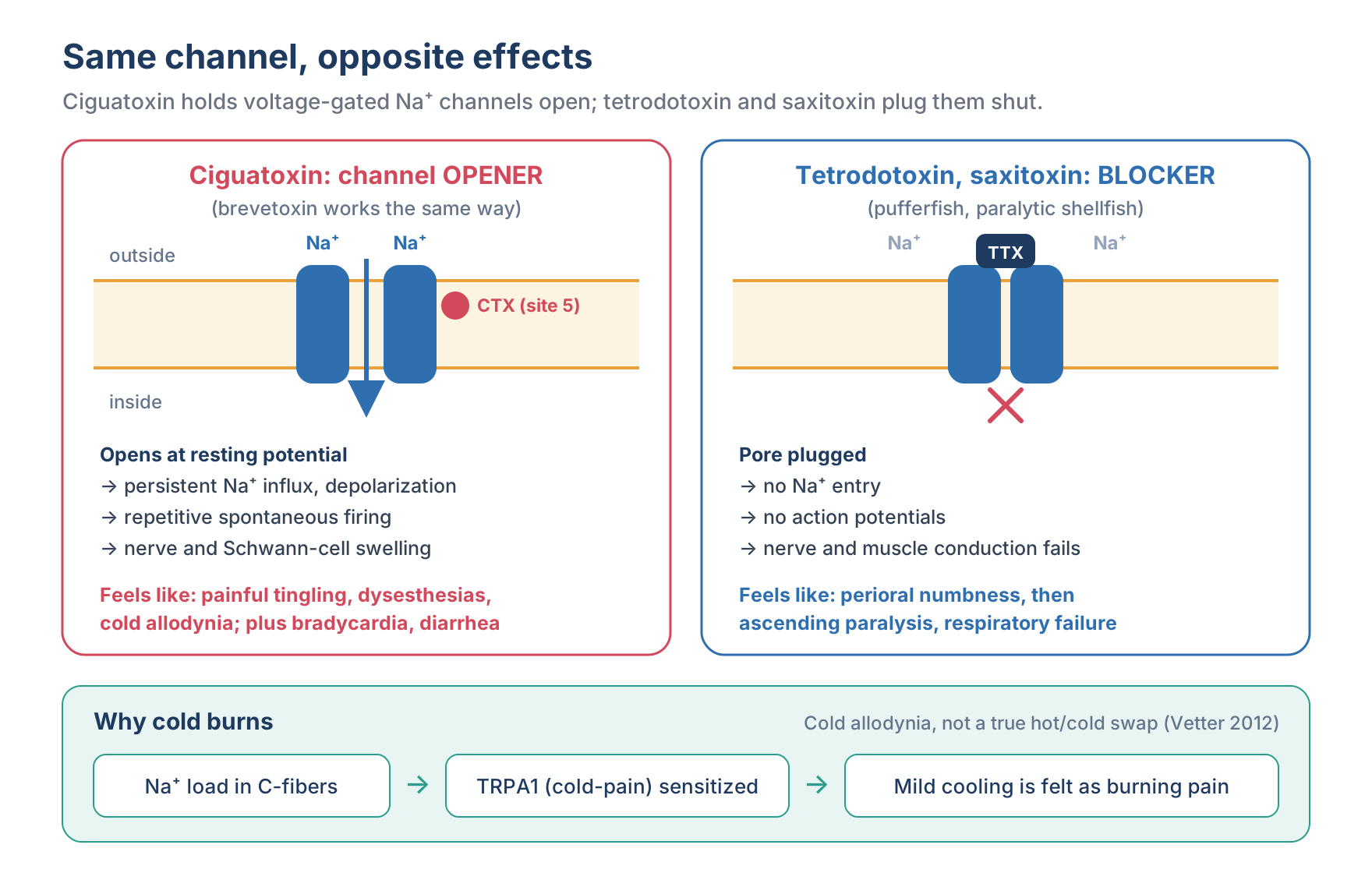
- Binds site 5 of voltage-gated sodium channels so they open at resting membrane potential.
- Persistent sodium influx causes depolarization and repetitive spontaneous firing, especially in small sensory fibers. Water follows, causing neuronal and Schwann-cell swelling and slower nerve conduction. That edema is the rationale for mannitol.
- Why cold burns: the sodium load sensitizes TRPA1, the cold-pain receptor on C-fibers, so mild cooling triggers burning pain (Vetter 2012).
- Why the diarrhea: channel opening in the intestinal epithelium drives calcium-mediated fluid secretion, a secretory diarrhea without tissue damage.
- Contrast with tetrodotoxin and saxitoxin, which block the same channels and cause numbness and paralysis instead.
‘Temperature reversal’ is really cold allodynia: cold is felt as burning pain. It is not a true swap of hot and cold.
Recognition and Diagnosis
Timing
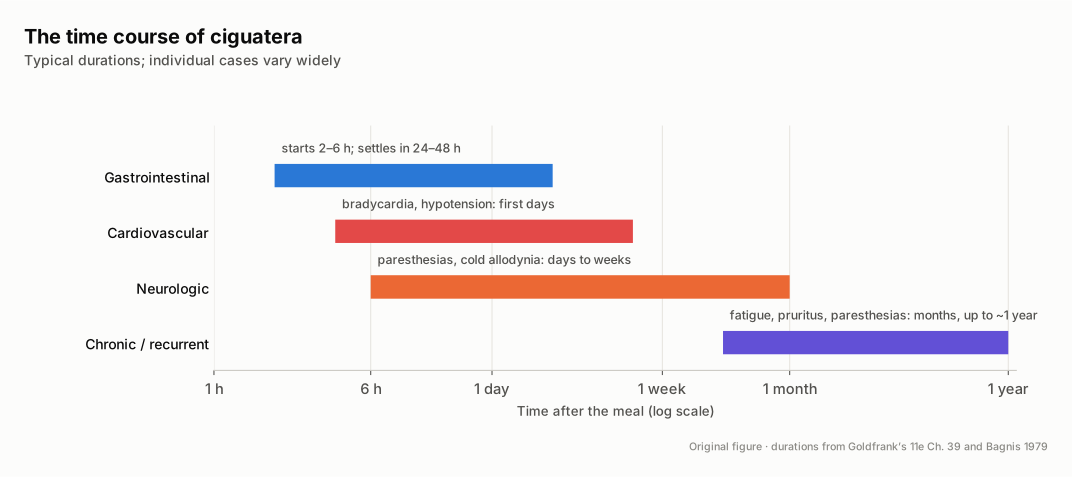
- Most cases start 2–6 h after the meal; 96% within 24 h (Bagnis 1979, 3,009 cases).
- GI symptoms dominate the first 12 h and usually settle in 24–48 h (occasionally up to 4 days). Cardiovascular effects belong to the first days.
- Neurologic symptoms last days to weeks, and about 20% of patients still have symptoms months later.
Prolonged cases get mislabeled as MS or chronic fatigue. Ask about tropical travel and fish meals in anyone with unexplained relapsing paresthesias.
Key Clinical Features
System | Findings |
GI (first) | Nausea, vomiting, cramping abdominal pain, profuse watery diarrhea, diaphoresis |
Neurologic (hallmark) | Perioral and distal paresthesias; cold allodynia; metallic taste; ‘loose’ or painful teeth; myalgias, arthralgias; ataxia, weakness, vertigo; pruritus (often late). Rarely seizures, coma |
Cardiovascular | Bradycardia, hypotension (often orthostatic), occasionally AV block |
Genitourinary | Dysuria; painful intercourse for patients and their partners (toxin likely passes in semen) |
Neuropsychiatric | Fatigue, depressed mood, poor concentration; can be prolonged |
- How common: in one ED series, 94% had GI symptoms, 76% neurologic signs and 40% bradycardia or hypotension. Bradycardia was present in 71% of ED patients, and 16% had a heart rate ≤ 40 (Boucaud-Maitre 2018).
- Pregnancy and breastfeeding: ciguatoxin crosses the placenta and is thought to pass into breast milk.
- Severity: most cases are self-limited and death is rare (< 0.1%). Deaths come from respiratory failure, seizures or cardiovascular collapse, and are linked to eating the head or viscera and to large portions.
Cold allodynia is classic but occurs in only about half of cases, and also occurs in neurotoxic shellfish poisoning. Its absence doesn’t exclude ciguatera.
Making the Diagnosis
There is no clinical test for ciguatoxin in humans. The diagnosis rests on:
- GI illness within hours of eating a tropical or subtropical reef fish, followed by
- Neurologic symptoms, especially perioral paresthesias and cold allodynia, and
- Ideally, others who ate the same fish getting sick.
Labs are for excluding other causes and guiding fluid replacement: electrolytes, glucose and an ECG for bradycardia. Leftover fish can be tested by the FDA, but results take weeks. Save and freeze it.
Call the poison center or health department early: they may already know about other cases from the same source.
Differential and Mimics
Syndrome | Source | Mechanism | Onset | Key features |
Ciguatera | Large reef fish | Na channel opener | 2–24 h | GI then paresthesias, cold allodynia, bradycardia; lasts days–months |
Neurotoxic shellfish (brevetoxin) | Bivalves, ‘red tide’ | Na channel opener | 15 min–18 h | Looks like mild ciguatera; aerosolized toxin causes bronchospasm |
Paralytic shellfish (saxitoxin) | Bivalves | Na channel blocker | ~30 min | Paresthesias → respiratory paralysis |
Tetrodotoxin | Pufferfish, blue-ringed octopus | Na channel blocker | Minutes–hours | Perioral numbness → ascending paralysis, hypotension |
Amnestic shellfish (domoic acid) | Mussels | Glutamate agonist | 15 min–38 h | GI, then confusion, amnesia, seizures |
Scombroid | Tuna, mahi-mahi, mackerel | Histamine | Minutes–1 h | Flushing, headache, peppery taste; resolves with H1/H2 blockers |
Botulism | Home-canned food | Blocks ACh release | 12–72 h | Descending paralysis, cranial nerves first |
- Also consider: gastroenteritis with dehydration, organophosphates, heavy metals (arsenic, thallium), Guillain-Barré, and anticholinergic poisoning.
- Ciguatera vs brevetoxin is often impossible to call: same mechanism, near-identical syndrome. Reef fish points to ciguatera and shellfish to brevetoxin; a mixed seafood meal may leave it unresolved.
Openers (ciguatera, brevetoxin) cause painful tingling; blockers (saxitoxin, tetrodotoxin) cause numbness and paralysis.
Treatment
Treatment is supportive. There is no antidote, and mannitol remains reasonable but unproven.
Supportive Care
- ABCs. Generalized weakness can precede respiratory failure. Trend negative inspiratory force (NIF), use noninvasive ventilation early, and intubate if NIF is weaker than −30 cmH2O or weakness is progressing.
- Volume: IV fluids and electrolyte replacement for GI losses.
- Bradycardia: atropine if symptomatic; often not needed if blood pressure holds.
- Hypotension: fluids first, then α-agonist vasopressors (norepinephrine or phenylephrine) if it persists.
- Activated charcoal: possible benefit only in early presenters who aren’t vomiting. Most patients have already vomited or had diarrhea.
- Symptoms: antiemetics; antihistamines for pruritus. Prefer non-opioid analgesia; opioids are traditionally avoided, though this rests on theory rather than data.
Needing pressors is unusual in ciguatera. If you do, reconsider the diagnosis.
Mannitol
The rationale is sound: mannitol may reduce neuronal and Schwann-cell edema. The clinical evidence is weak.
Study | Design | Finding |
Palafox, JAMA 1988 | Case series | Dramatic improvement in neurologic symptoms; started the practice |
Schnorf, Neurology 2002 | Double-blind RCT, n = 50 | No difference vs normal saline at 24 h. The only RCT: small, mostly late treatment |
Schwarz, Ann Emerg Med 2008 | Case report | Improvement even when given weeks after exposure |
Mullins & Hoffman, Clin Toxicol 2017 | Systematic review | Most evidence of any treatment, but low quality; reasonable to consider in acute cases |
Sources disagree: some current EM references advise against routine use. Nearly everyone in the RCT improved with saline alone, so the dramatic case-series responses may partly reflect the natural course.
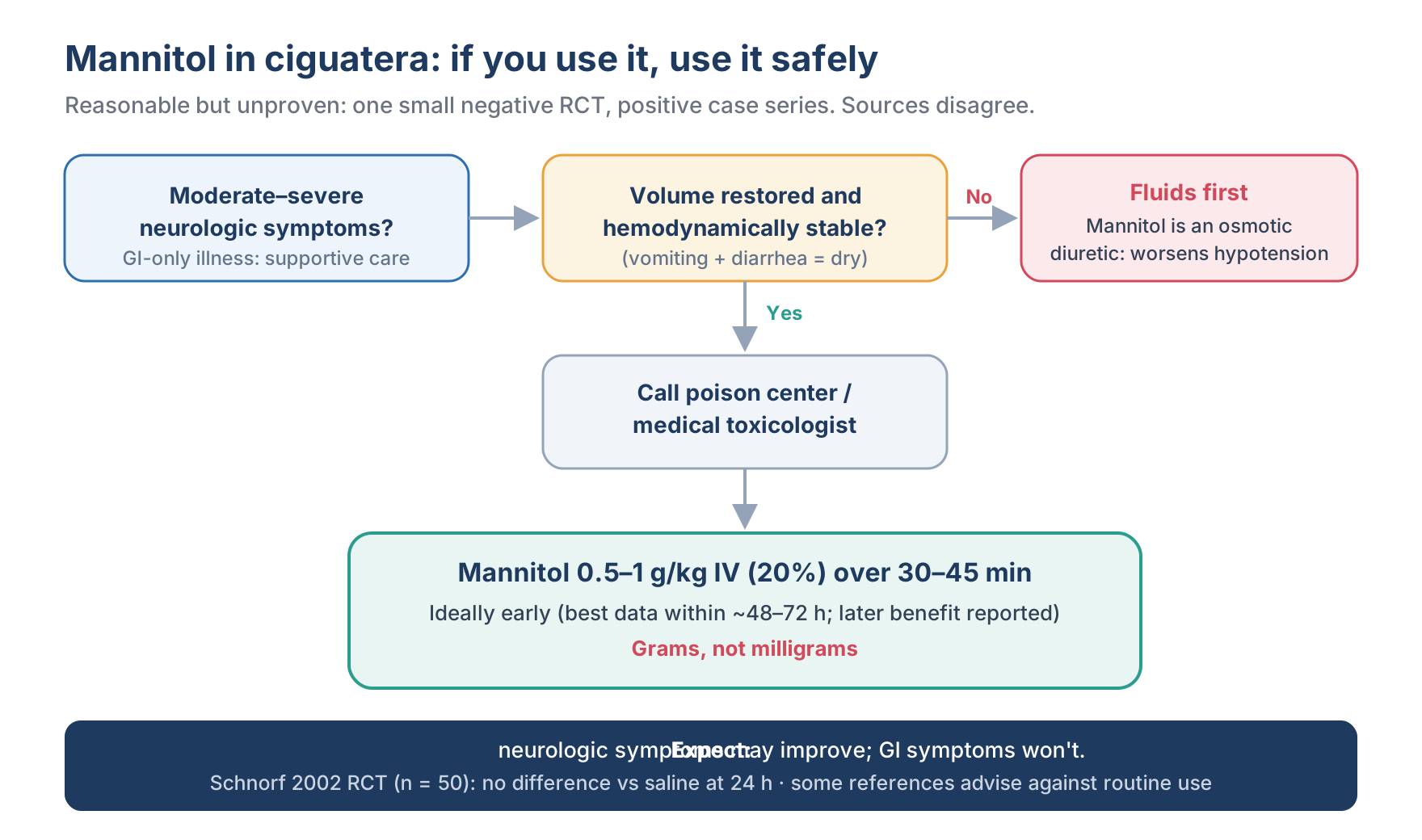
If you use it
- For moderate–severe neurologic symptoms, ideally early (best data within 48–72 h).
- Dose: 0.5–1 g/kg IV (20% solution) over 30–45 min, after discussion with a poison center or toxicologist.
- Only in hemodynamically stable, well-hydrated patients. Mannitol is an osmotic diuretic and can worsen hypotension.
- Don’t expect GI symptoms to improve.
Mannitol is dosed in grams, not milligrams, and only after volume is restored.
Persistent Symptoms
Evidence is limited to case reports and small series. Match the drug to the symptom:
- Neuropathic symptoms: gabapentin or pregabalin
- Chronic paresthesias and low mood: amitriptyline (25 mg PO BID has been used)
- Fatigue: fluoxetine
- Headache: nifedipine or acetaminophen
- Pruritus: antihistamines
Fatigue and mood symptoms can be disabling; validate them and arrange follow-up.
Recurrence and Counseling
- Symptoms often flare with alcohol, nuts, caffeine, fish, pork, chicken, dehydration and exertion. Avoid triggers for about 6 months. A second ciguatera exposure tends to be worse.
- Avoid reef predators from endemic areas (especially barracuda and moray eel), and never eat the head, skin, liver, viscera or roe of a reef fish. Smaller fish and smaller portions lower the dose.
- Cooking, freezing, marinating and folk tests don’t help.
- Nursing mothers should stop breastfeeding until asymptomatic. Sexual partners may develop symptoms; consider condoms or abstaining while symptomatic.
- Report cases to the health department so the fish source can be traced.
Set expectations: neurologic symptoms can last weeks to months and flare with alcohol and other triggers.
Disposition and Follow-Up
Clinical Course | Disposition |
Asymptomatic or mild after 6–8 h of ED observation, no neurologic or respiratory concern | Discharge with return precautions; follow-up in 1–2 days |
Uncertain diagnosis, significant volume depletion, bradycardia, hypotension or severe neurologic findings | Admit to a monitored bed |
Pressors, ventilatory support, or bradycardia or dysrhythmia needing close monitoring | ICU admission |
TL;DR
Topic | Bottom line |
Exposure | Tropical reef fish, especially barracuda, grouper, amberjack; ask where it was caught |
Presentation | GI illness in 2–6 h, then paresthesias, cold allodynia, bradycardia |
Diagnosis | Clinical; no human test. Call the poison center or health department |
Treatment | Supportive: fluids, atropine, pressors if needed; watch NIF |
Mannitol | Unproven; if used, 0.5–1 g/kg early, only once volume-replete |
Course | Neurologic symptoms for weeks to months; avoid alcohol and other triggers for about 6 months |
Sources
- Fil LJ, Tunik MG. Food poisoning. In: Nelson LS, Howland MA, Lewin NA, et al., eds. Goldfrank’s Toxicologic Emergencies. 11th ed. McGraw-Hill; 2019: Ch. 39.
- Bagnis R, Kuberski T, Laugier S. Clinical observations on 3,009 cases of ciguatera (fish poisoning) in the South Pacific. Am J Trop Med Hyg. 1979;28:1067-1073. doi:10.4269/ajtmh.1979.28.1067
- Friedman MA, Fleming LE, Fernandez M, et al. Ciguatera fish poisoning: treatment, prevention and management. Mar Drugs. 2008;6(3):456-479. PMC
- Friedman MA, et al. An updated review of ciguatera fish poisoning. Mar Drugs. 2017;15(3):72.
- Palafox NA, et al. Successful treatment of ciguatera fish poisoning with intravenous mannitol. JAMA. 1988;259:2740-2742.
- Schnorf H, Taurarii M, Cundy T. Ciguatera fish poisoning: a double-blind randomized trial of mannitol therapy. Neurology. 2002;58:873-880. PubMed
- Schwarz ES, Mullins ME, Brooks CB. Ciguatera poisoning successfully treated with delayed mannitol. Ann Emerg Med. 2008;52:476-477. doi:10.1016/j.annemergmed.2008.05.015
- Mullins ME, Hoffman RS. Is mannitol the treatment of choice for patients with ciguatera fish poisoning? Clin Toxicol. 2017;55:947-955. doi:10.1080/15563650.2017.1327664
- Vetter I, Touska F, Hess A, et al. Ciguatoxins activate specific cold pain pathways to elicit burning pain from cooling. EMBO J. 2012;31(19):3795-3808. doi:10.1038/emboj.2012.207
- Fasano A, Hokama Y, Russell R, Morris JG Jr. Diarrhea in ciguatera fish poisoning: preliminary evaluation of pathophysiological mechanisms. Gastroenterology. 1991;100(2):471-476.
- Boucaud-Maitre D, Vernoux JP, Pelczar S, et al. Incidence and clinical characteristics of ciguatera fish poisoning in Guadeloupe (French West Indies) between 2013 and 2016. Sci Rep. 2018. PMC
- Morihara C, et al. Clinicoepidemiological profile of ciguatera cardiotoxicity: a systematic review. Am J Trop Med Hyg. 2024.
- Chan TY. Characteristic features and contributory factors in fatal ciguatera fish poisoning. Epidemiol Infect. 2012;140:1008-1012.
- Foodborne disease outbreaks associated with marine toxins, United States, 2011–2023. MMWR Surveill Summ. 2026;75(SS-3):1-13. doi:10.15585/mmwr.ss7503a1
- Ansdell VE. Food poisoning from marine toxins. CDC Yellow Book. 2026. Link
- Brandehoff N. Seafood Toxicity and Poisoning. CorePendium (EM:RAP). Updated January 3, 2025. Link
- emDocs. Seafood Poisoning and Toxidromes. 2021.
- emDocs. ToxCard: Shellfish Poisoning. 2021.
- LITFL. Ciguatera Poisoning. 2019.
- LITFL. Why do my hands feel so cold? 2018.
- First10EM. Rapid Review: Ciguatera Poisoning. 2017.
This post is educational and not medical advice.