
Persistent hiccups: dangerous causes, maneuvers and drug options.
Last updated November 2026
Definitions & Concepts
What Are Hiccups?
A hiccup (singultus) is an involuntary spasm of the diaphragm and inspiratory intercostal muscles, cut short about 35 ms later by sudden glottic closure. That closure makes the “hic.” Hiccups serve no known purpose in adults.
- Almost everyone gets them; most bouts stop on their own within minutes.
- In the ED, the job is to sort the benign bout from persistent hiccups that signal disease, then stop them.
Classification by Duration
Type | Duration | What it usually means |
Acute bout | Under 48 h | Benign: gastric distention, carbonated drinks, alcohol, smoking, sudden temperature change, emotion |
Persistent | 48 h to 1 month | Look for a cause: reflux, a drug, metabolic derangement, or irritation of the vagus or phrenic nerve |
Intractable | Over 1 month | Same search, wider: CNS lesion, cancer, structural chest or abdominal disease |
The 48-hour mark is the dividing line. Before it, treat the symptom. After it, hiccups are a sign, and you need a cause.
Who Gets Persistent Hiccups
- Persistent and intractable hiccups are much more common in men when the cause is outside the CNS (OR 11.7, 95% CI 3.2–43.5); with CNS causes the sex difference is small (OR 1.7) (Lee 2016).
- Higher-risk groups: reflux disease (up to 10%), advanced cancer (roughly 2–9%, depending on setting), Parkinson disease (about 20% report recurrent hiccups), and recent surgery or anesthesia.
- Hiccups can be an early cancer sign. In a Swedish cohort of 8,466 patients with hiccups (89% men), 3.8% were later diagnosed with cancer, most often within 12 months. In men, esophageal cancer was 2.6 times more common than expected (Jansåker 2025).
- Even with a long list of possible causes, most persistent cases end up as idiopathic chronic hiccups (Minor Emergencies 2022).
Pathophysiology
The Reflex Arc
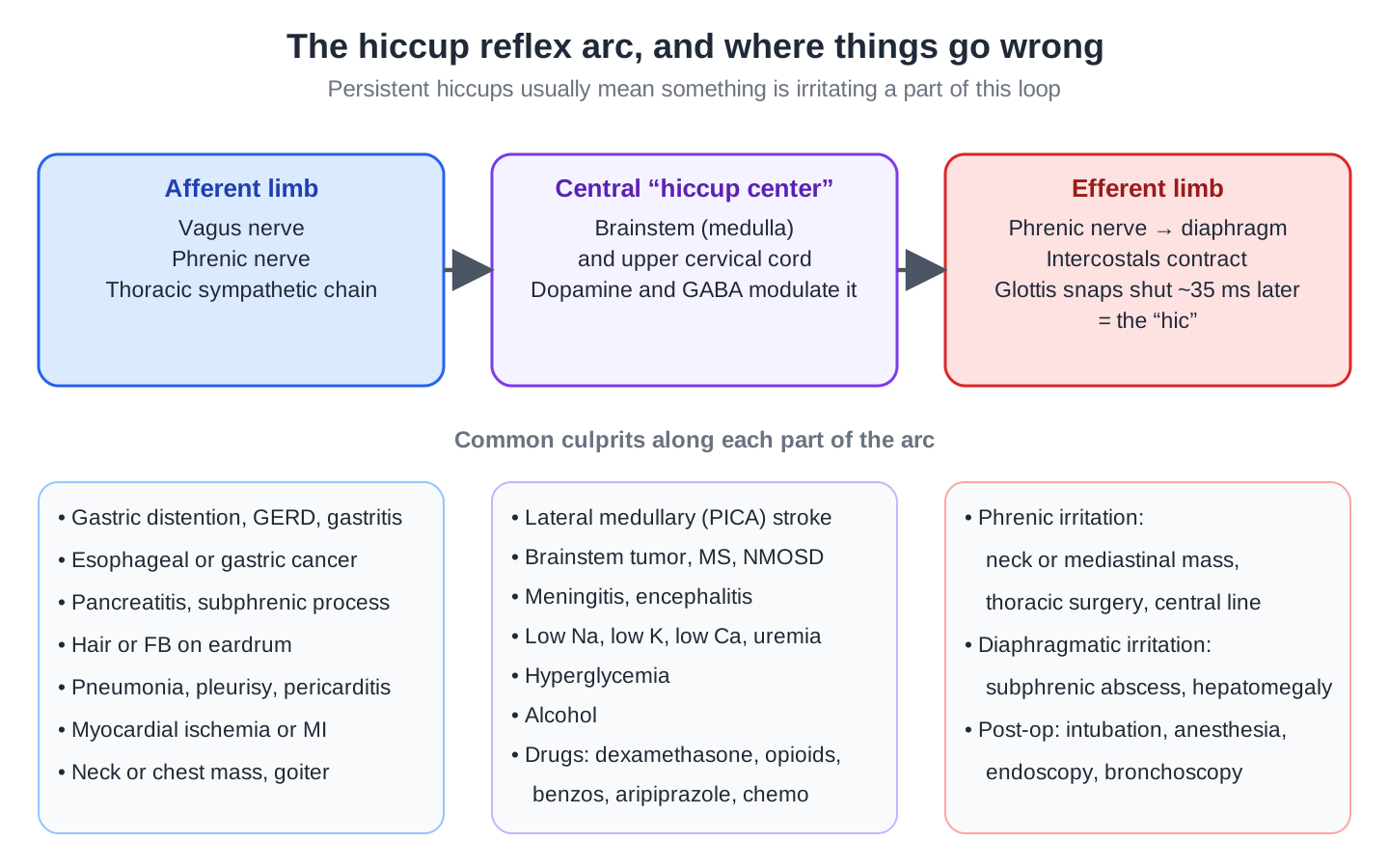
- Afferent limb: vagus nerve, phrenic nerve and the thoracic sympathetic chain.
- Central processing: a “hiccup center” in the brainstem (medulla) and upper cervical cord, modulated by dopamine and GABA. This is why dopamine blockers and GABA-B agonists (baclofen) work.
- Efferent limb: the phrenic nerve to the diaphragm (often just the left hemidiaphragm) and intercostals, then glottic closure.
- Normally inspiration inhibits glottic closure. The hiccup reflex breaks that link, so the glottis slams shut mid-breath.
Persistent hiccups mean something is irritating one part of this arc. Walk it from ear and gut, through the chest and brainstem, to the diaphragm.
Why Alcohol and Big Meals Trigger Them
- Gastric distention (a large meal, carbonated drinks, swallowed air) stretches the stomach and irritates vagal afferents. It is the most common trigger.
- Alcohol loosens the normal coupling between inspiration and glottic closure, so smaller stimuli set off the reflex.
Recognition and Diagnosis
History
- Duration sets the workup: under 48 h, a bout; longer, look for a cause.
- Does it continue in sleep? Hiccups that stop during sleep suggest a psychogenic cause; persistence during sleep favors an organic one. The distinction isn’t absolute.
- Red-flag symptoms: chest pain, dyspnea, dysphagia, weight loss, vomiting, vertigo, diplopia, weakness, numbness, confusion.
- Cancer screen: fevers, sweats, weight loss, abdominal pain, lumps or nodes, early satiety, prior cancer.
- Reflux symptoms: heartburn, regurgitation, sour taste. Make sure “heartburn” isn’t acute coronary syndrome.
- Alcohol: heavy drinking is strongly linked to hiccups.
- Medications: dexamethasone and other corticosteroids, opioids, benzodiazepines, short-acting barbiturates, aripiprazole and other dopamine agonists, azithromycin, chemotherapy (especially platinum agents).
- Cardiac history: coronary disease or its risk factors, and a pacemaker or ICD. Pacing leads can stimulate the phrenic nerve or diaphragm: a laterally placed atrial lead, a coronary sinus (LV) lead, or an RV lead, especially one that has perforated. Hiccups that start long after implant suggest perforation or an insulation break.
- Recent procedures: intubation, anesthesia, endoscopy, bronchoscopy, central line, thoracic or abdominal surgery.
- Impact: eating, sleeping, weight loss and exhaustion. Intractable hiccups can cause malnutrition, dehydration and aspiration.
Exam
- Look in both ears. A hair or foreign body against the tympanic membrane stimulates the auricular branch of the vagus. Rare, but removing it cures the hiccups.
- Neuro exam: cranial nerves, nystagmus, dysarthria, gait and cerebellar testing. Hiccups with vertigo, vomiting and dysphagia point to a lateral medullary (Wallenberg) stroke. Also look for focal continuous seizures. Among demyelinating diseases, Neuromyelitis optica spectrum disorder (NMOSD) can be a cause of intractable hiccups; MS is a rarer one.
- Is it really a hiccup? Myoclonus and tics can look similar.
- Neck, chest and abdomen: goiter or neck mass, focal lung findings, rub, epigastric tenderness, hepatomegaly.
- General: cachexia, jaundice, pallor, lymphadenopathy, hepatosplenomegaly, abdominal mass.
Hiccups can be the presenting symptom of a posterior circulation stroke. In one MRI series, every patient with lateral medullary infarction and hiccups also had vertigo, nausea or vomiting, and dysphagia (Park 2005). Examine gait and swallowing.
Workup
Acute bouts with a normal exam need nothing. Much of the workup for prolonged hiccups is best done as an outpatient, since it can take several tests over time. Do some testing in the ED for older or high-risk patients, such as a chest X-ray in someone with prior lung cancer (CorePendium 2023). For persistent hiccups, let the history and exam guide you:
Test | When | Looking for |
BMP, Ca, Mg, glucose | All persistent hiccups | Hyponatremia, hypokalemia, hypocalcemia, uremia, hyperglycemia |
CBC, lipase | Infection or abdominal findings | Infection, pancreatitis |
ECG ± troponin | Chest pain, dyspnea, cardiac risk | Myocardial ischemia or MI |
Chest X-ray | All persistent hiccups | Mass, effusion, pneumonia, raised hemidiaphragm |
CT or MRI brain, CTA head/neck | Any neuro finding | Brainstem stroke, mass, demyelination |
CT chest or abdomen, EGD | Weight loss, dysphagia | Esophageal, gastric or lung cancer |
Ethanol, toxicology | Suspected ingestion | Alcohol, drugs |
Check electrolytes and an ECG before you give chlorpromazine. Low potassium or magnesium adds to its QT risk, and correcting the derangement may treat the hiccups. Electrolyte causes are documented only in case reports, such as an ED patient whose profound hyponatremia and hypokalemia presented as hiccups (Gardecki 2017).
Don’t assume hiccups are benign in a patient with coronary disease, CAD risk factors or a pacemaker. A screening ECG is cheap and reasonable, especially in older or diabetic patients. The evidence is case reports: one man with diabetes was discharged after lorazepam and IM chlorpromazine and returned 2 days later with an NSTEMI (Davenport 2012), and three more MIs presented with hiccups alone (Kao 2019).
Dangerous Causes Not to Miss
Cause | Clue |
Lateral medullary stroke | Vertigo, vomiting, dysphagia, ataxia, Horner, crossed sensory loss |
Myocardial ischemia, MI or pericarditis | Chest pain, diaphoresis, risk factors, a rub; get an ECG |
Pacemaker lead problem | Hiccups in time with pacing. Get a CXR and device interrogation to exclude lead perforation; reprogramming the pacing output or vector can stop it |
Arrhythmia | Syncope with hiccups; arrhythmias are reported as both cause and effect |
Severe electrolyte derangement | Hyponatremia, hypokalemia, hypocalcemia, uremia |
NMOSD (area postrema syndrome) | Hiccups with nausea and vomiting for at least 48 h with no other cause. It is the first sign of NMOSD in about 10% of patients. Ask about vision loss or myelitis; MRI brain and cervical cord, aquaporin-4 antibodies (Wingerchuk 2022) |
Cancer | Weight loss, dysphagia: esophageal, gastric, lung, mediastinal or CNS tumor |
Thoracic or abdominal process | Pneumonia, pericarditis, pancreatitis, subphrenic abscess, pleural effusion |
Treatment
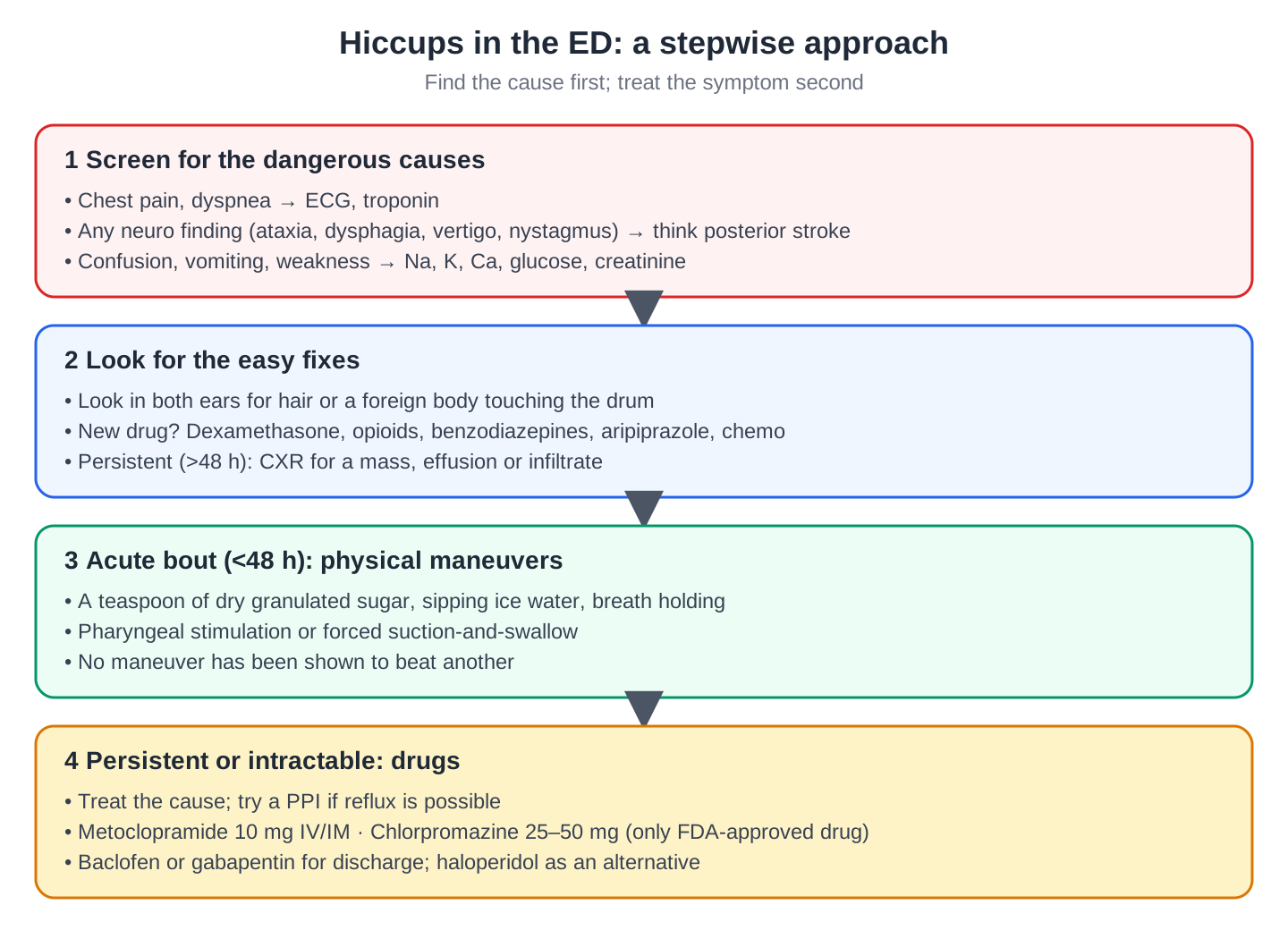
Treat the cause whenever you find one. Stopping the drug, removing the hair from the ear or correcting the sodium often works better than any antihiccup medication.
Physical Maneuvers (Acute Bouts)
Most maneuvers stimulate the pharynx or vagus to interrupt the reflex arc. None is clearly better than another, so choose the least unpleasant (Tintinalli 2020):
- Dry granulated sugar, placed at the base of the tongue and left to dissolve. Tintinalli suggests a teaspoon; Minor Emergencies suggests a tablespoon. About as effective as the others, and painless.
- Soft palate stimulation: rub the soft palate with a swab, spoon, catheter tip or gloved finger, stopping just short of a gag. Repeat a few times if needed. A nasogastric tube to the posterior pharynx works the same way.
- Sipping ice water, or drinking water quickly.
- Breath holding, Valsalva, or pulling the knees to the chest and leaning forward.
- Modified Valsalva: blowing into a syringe is easy for patients to do (Core EM).
- Biting a lemon, or briefly inhaling a noxious smell such as ammonia.
- Pulling on the tongue, or rubbing the eyes.
- Holding the knees firmly to the chest for about 30 seconds.
- Forced inspiratory suction and swallow: sucking water hard through a straw with a resistance valve, then swallowing. In an uncontrolled survey of 249 users, about 92% said it stopped their hiccups (Alvarez 2021).
The sugar trick is cheap, available in every ED and harmless. Use it before reaching for antipsychotics.
Drugs for Persistent or Intractable Hiccups
Evidence is thin: a Cochrane review found too little data to recommend any treatment, and only baclofen and metoclopramide have small RCTs behind them (Moretto 2013; Polito 2017). Choose by side-effect profile and the likely cause.
Drug | ED dose | Discharge dose | Notes |
PPI (omeprazole, pantoprazole) ± antacid | Omeprazole 20 mg or pantoprazole 40 mg daily before a meal; liquid antacid with simethicone 10 mL every 6–8 h as needed | Same | Reasonable first step when reflux is possible |
Metoclopramide | 10 mg IV or IM | 10 mg PO TID, short course (5 mg per dose if CrCl ≤ 60 or older adult) | One small RCT. Acute dystonia (mostly in the first 24–48 h and in patients under 30) and tardive dyskinesia. Avoid in Parkinson disease, epilepsy, bowel obstruction, pheochromocytoma or prior tardive dyskinesia |
Chlorpromazine | Label order: 25–50 mg PO TID–QID; if hiccups persist 2–3 days, 25–50 mg IM; if they still persist, a slow IV infusion of 25–50 mg in 500–1,000 mL saline with the patient flat and BP monitored | 25–50 mg PO TID–QID | Only FDA-approved drug. Never give undiluted IV; keep the patient lying down at least 30 min after any injection. Treat hypotension with fluids, then norepinephrine or phenylephrine (not epinephrine). Avoid in older adults with dementia. Sedation, dystonia, QT prolongation, tardive dyskinesia |
Haloperidol | 2–5 mg IM | 1–4 mg PO TID (Minor Emergencies: for 2 days) | Alternative dopamine blocker with less hypotension than chlorpromazine; QT and dystonia |
Baclofen | 10 mg PO | 10–20 mg PO BID–TID, up to 75 mg/day | One small RCT. Gabapentin can be added, especially in solid cancers. Sedation, confusion; nausea and drowsiness are more common above 45 mg/day. Avoid on dialysis or with CrCl below 30 (encephalopathy); halve the dose at CrCl 30–50 |
Gabapentin | 100–300 mg PO | 100–300 mg PO TID, titrated to effect, usually up to 1,200 mg/day | Start at 100 mg TID in older or frail patients or with opioids. Sedation, dizziness; reduce dose if CrCl is below 60 |
Nifedipine | 10–20 mg PO | 10–20 mg PO TID–QID | Hypotension; usually started by primary care |
Midazolam | 5–10 mg IV, for intractable hiccups | — | Case reports only. Benzodiazepines can also cause hiccups, especially chronic high doses. Watch for respiratory depression |
Lidocaine | Nebulized to the posterior oropharynx before other drugs; or, if refractory and distressing, IV 1–1.5 mg/kg at 2 mg/min, with an extra 0.5 mg/kg if needed | — | Case reports only. Nebulized: the gag reflex is lost, so nothing by mouth until it returns. IV: continuous cardiac monitoring, with lipid emulsion on hand for local anesthetic toxicity |
Valproic acid, phenytoin, carbamazepine | Typical anticonvulsant doses (valproate 15 mg/kg PO) | Same | For intractable hiccups; usually started by primary care or a specialist |
Doses adapted from Tintinalli 2020 (Table 62-7), Minor Emergencies 2022, CorePendium 2023, the chlorpromazine FDA label and Thompson 2013 (gabapentin).
- Lower starting doses are also used: metoclopramide 5–10 mg IV or IM, haloperidol 1 mg PO every 8 h, baclofen 5–10 mg PO every 8 h. Chlorpromazine is the only FDA-approved drug but is not widely used in practice (CorePendium 2023).
- Chlorpromazine IV in the ED before an oral trial departs from the label. The label only says “slow”: the “over at least an hour”, “repeat in 2–4 h” and saline pre-bolus advice in EM references doesn’t come from it. Watch the 0.5–1 L volume in heart failure or dialysis patients.
- Metoclopramide: 10 mg per dose
- Gabapentin: published hiccup regimens go up to 1,200 mg/day.
- Don’t stack dopamine blockers. Metoclopramide followed by chlorpromazine or haloperidol adds to the risk of dystonia and other extrapyramidal effects.
No drug is proven better than another, and published algorithms disagree: some put baclofen first, others chlorpromazine. A practical approach is a single dose of metoclopramide in the ED (especially with reflux), with baclofen or gabapentin as the discharge drug. Keep chlorpromazine for refractory cases, given lying down after checking BP, QT and electrolytes.
The Evidence
- Baclofen: in stroke patients with persistent hiccups, 10 mg TID for 5 days stopped hiccups far more often than placebo (n = 30; RR 7.0) (Zhang 2014).
- Metoclopramide: 10 mg TID for 15 days improved or stopped intractable hiccups in 11 of 17 patients vs 4 of 17 on placebo (RR 2.75) (Wang 2014).
- PPIs: in a study of 266 reflux patients, PPI therapy was linked to hiccup resolution, but only 12 actually had both reflux and hiccups. The data support a PPI trial in patients with reflux, nothing more (CorePendium 2023).
- These two 2014 trials are still the only placebo-controlled drug trials for hiccups.
- Chlorpromazine: the only FDA-approved drug, approved on the strength of two 1950s case series of IV use. Oral efficacy has never been reported (Steger 2015).
- Gabapentin, haloperidol, olanzapine, nifedipine, valproate, midazolam, lidocaine: case reports and series only (Polito 2017; Steger 2015).
- A 2025 review of 88 studies in palliative care rated all the evidence very low certainty; gabapentin and baclofen were the most often reported to work (Das 2025).
Special Situations
- Dexamethasone-induced hiccups (common with chemotherapy antiemetic regimens): switching to an equivalent dose of methylprednisolone or prednisolone stopped the hiccups in a case series of 5 patients (Kang 2012).
- Opioid-induced hiccups: consider rotating to a different opioid; one case report resolved after a switch to fentanyl (Xausa 2023).
- Aripiprazole: hiccups usually start within 1–2 days of the first dose and settle within days of stopping it (Zhang 2023).
- Palliative care and cancer: treat reversible causes (gastric distention, drugs, electrolytes); baclofen, metoclopramide and gabapentin are the usual choices.
- Refractory intractable hiccups: referral options include phrenic nerve block, acupuncture, hypnosis and, rarely, surgery.
Disposition and Follow-Up
No guideline or validated admission criteria exist, so this table is consensus-based. Most drugs take hours or longer to work, so discharging on ongoing oral therapy with primary care follow-up is usually right. When the history points strongly to a cause, refer directly: for example, a patient with known gastric cancer, early satiety and days of hiccups to GI or oncology (CorePendium 2023).
Clinical Course | Disposition |
Acute bout that stopped; normal exam | Discharge; no follow-up needed |
Persistent hiccups, workup unrevealing, eating and drinking | Discharge on an oral agent (PPI, metoclopramide, baclofen or gabapentin); primary care follow-up within a week |
Intractable hiccups without a cause found | Outpatient workup: EGD and CT chest/abdomen (especially in men, given the cancer link); MRI brain and cervical cord with aquaporin-4 antibodies if there is vomiting; GI or neurology referral |
Stroke, MI, significant metabolic derangement, or a mass needing urgent workup | Admit |
Syncope with hiccups | Admit for monitoring and arrhythmia workup |
Unable to eat, drink or sleep; dehydration, aspiration or exhaustion | Admit for symptom control |
TL;DR
Topic | Bottom line |
Definitions | Bout under 48 h; persistent 48 h to 1 month; intractable over 1 month |
Acute bout | Reassure; try a teaspoon of sugar or other maneuvers |
Persistent | Look for a cause: ears, drugs, electrolytes, CXR, ECG, neuro exam |
Don’t miss | Lateral medullary stroke, MI, hyponatremia, NMOSD, cancer |
Drugs | No drug is proven best. Metoclopramide 10 mg IV once in the ED; baclofen or gabapentin at discharge; chlorpromazine if refractory (label: PO, then IM, then slow diluted IV, supine) |
Dispo | Most go home; admit for a dangerous cause or if they can’t eat, drink or sleep |
Sources
- Hiccups. In: Tintinalli JE, et al., eds. Tintinalli’s Emergency Medicine: A Comprehensive Study Guide. 9th ed. McGraw-Hill; 2020: Ch. 62 (Respiratory Distress), pp. 429–430.
- Singultus (hiccups). In: Buttaravoli P, Leffler S, Herrington RR, eds. Minor Emergencies. 4th ed. Elsevier; 2022: Ch. 75.
- Polito NB, Fellows SE. Pharmacologic interventions for intractable and persistent hiccups: a systematic review. J Emerg Med. 2017;53(4):540-549. doi:10.1016/j.jemermed.2017.05.033
- Moretto EN, Wee B, Wiffen PJ, Murchison AG. Interventions for treating persistent and intractable hiccups in adults. Cochrane Database Syst Rev. 2013;(1):CD008768. doi:10.1002/14651858.CD008768.pub2
- Steger M, Schneemann M, Fox M. Systemic review: the pathogenesis and pharmacological treatment of hiccups. Aliment Pharmacol Ther. 2015;42(9):1037-1050. doi:10.1111/apt.13374
- Zhang C, et al. Baclofen for stroke patients with persistent hiccups: a randomized, double-blind, placebo-controlled trial. Trials. 2014;15:295. doi:10.1186/1745-6215-15-295
- Wang T, et al. Metoclopramide for patients with intractable hiccups: a multicentre, randomised, controlled pilot study. Intern Med J. 2014;44(12a):1205-1209. doi:10.1111/imj.12542
- Park MH, Kim BJ, Koh SB, et al. Lesional location of lateral medullary infarction presenting hiccups (singultus). J Neurol Neurosurg Psychiatry. 2005;76(1):95-98. doi:10.1136/jnnp.2004.039362
- Pache F, Wildemann B, Paul F, Jarius S. Neuromyelitis optica. Fortschr Neurol Psychiatr. 2017;85(2):100-114. doi:10.1055/s-0042-124186
- Gardecki J, Espinosa J, Lucerna A, Bernhardt J. Singultus: avoiding a hiccup in care. Am J Emerg Med. 2017;35(6):938.e1-938.e3. doi:10.1016/j.ajem.2016.12.056
- Kang JH, Hui D, Kim MJ, et al. Corticosteroid rotation to alleviate dexamethasone-induced hiccup: a case series at a single institution. J Pain Symptom Manage. 2012;43(3):625-630. doi:10.1016/j.jpainsymman.2011.04.011
- Xausa G, et al. Recurrent persistent hiccups on opioid treatment: a case report and literature review. J Pain Palliat Care Pharmacother. 2023;37(1):82-90. doi:10.1080/15360288.2022.2157070
- Zhang Y, et al. Persistent hiccups due to aripiprazole: a case report and review of the literature. Front Pharmacol. 2023;14:1284510. doi:10.3389/fphar.2023.1284510
- Alvarez J, et al. Evaluation of the forced inspiratory suction and swallow tool to stop hiccups. JAMA Netw Open. 2021;4(6):e2113933. doi:10.1001/jamanetworkopen.2021.13933
- He J, et al. Pathogenesis and treatment of perioperative hiccups: a narrative review. Ann Med. 2025;57(1):2474173. doi:10.1080/07853890.2025.2474173
- Thompson DF, Brooks KG. Gabapentin therapy of hiccups. Ann Pharmacother. 2013;47(6):897-903. doi:10.1345/aph.1S018
- Lee GW, Kim RB, Go SI, et al. Gender differences in hiccup patients: analysis of published case reports and case-control studies. J Pain Symptom Manage. 2016;51(2):278-283. doi:10.1016/j.jpainsymman.2015.09.013
- Jansåker F, Li X, Sundquist K. Associations between hiccups and subsequent cancer diagnoses: a population-based cohort study. Cancer Med. 2025;14(23):e71441. doi:10.1002/cam4.71441
- Davenport J, Duong M, Lanoix R. Hiccups as the only symptom of non-ST-segment elevation myocardial infarction. Am J Emerg Med. 2012;30(1):266.e1-2. doi:10.1016/j.ajem.2010.12.004
- Kao CC, Yen DH, Lee YT. Hiccups as the only symptom of acute myocardial infarction. Am J Emerg Med. 2019;37(7):1396.e1-1396.e3. doi:10.1016/j.ajem.2019.04.023
- Das A, Halpin S, Kondasinghe JS. Pharmacotherapy for chronic & intractable hiccups in palliative care: a mixed methods systematic & umbrella review. J Pain Symptom Manage. 2026;71(3):e336-e358. doi:10.1016/j.jpainsymman.2025.11.010
- Wingerchuk DM, Lucchinetti CF. Neuromyelitis optica spectrum disorder. N Engl J Med. 2022.
- Chlorpromazine hydrochloride. FDA prescribing information (label).
- Herbert M, Navarro MA. Singultus (hiccups). CorePendium (EM:RAP). Updated February 9, 2023.
- emDocs. EM@3AM: Hiccups. 2022.
- Core EM. Episode 68.0: Hiccups. 2016.
- LITFL. Hiccoughs. 2019.
- Taming the SRU. Diagnostics: Intractable Hiccups. 2024.
- Mayo Clinic EM Blog. Hiccups: Old Remedies for an Old Malady.
This post is educational and not medical advice.