

Last updated November 2026
Definitions & Concepts
What Is It?
Poisoning by carbon monoxide (CO), a colorless, odorless gas from incomplete combustion. It’s a leading cause of non-suicidal poisoning death in the US: about 1,170 deaths a year (2015–2021), more than 400 of them unintentional and not fire-related. Estimates run about 50,000 visits a year, with 1–3% mortality and some deaths are likely missed. Cases peak in December and January and often involve whole families. Children under 10 have the highest ED visit rates; adults over 80 have the highest hospitalization and death rates (Shin 2023). There is still no clear consensus on the best treatment.
Common Sources
Setting | Examples |
Home heating | Faulty furnaces, space heaters, wood or coal stoves, charcoal burned indoors for heat |
Power outages | Generators run indoors or in a garage during storms; clusters follow ice storms and hurricanes |
Engines | Cars in closed garages or with snow-blocked tailpipes, boats, forklifts, ice resurfacers |
Fires | Smoke inhalation; consider coexisting cyanide |
Methylene chloride | Paint strippers and varnishes; the liver turns it into CO, so levels can peak 8 h or more after exposure |
Hookah | Waterpipe smoking is an often-missed source, especially in younger patients |
Key Numbers
Situation | COHb half-life |
Room air | About 4–5 h (249–320 min) |
100% oxygen | About 1 h (74–80 min) |
Hyperbaric oxygen (2.5 ATA) | About 20 min |
Methylene chloride | 8–13 h, because CO keeps being made |
ACEP 2025 quotes about 5 hours on room air, 85 minutes on a high-flow non-rebreather and 20 minutes with HBO.
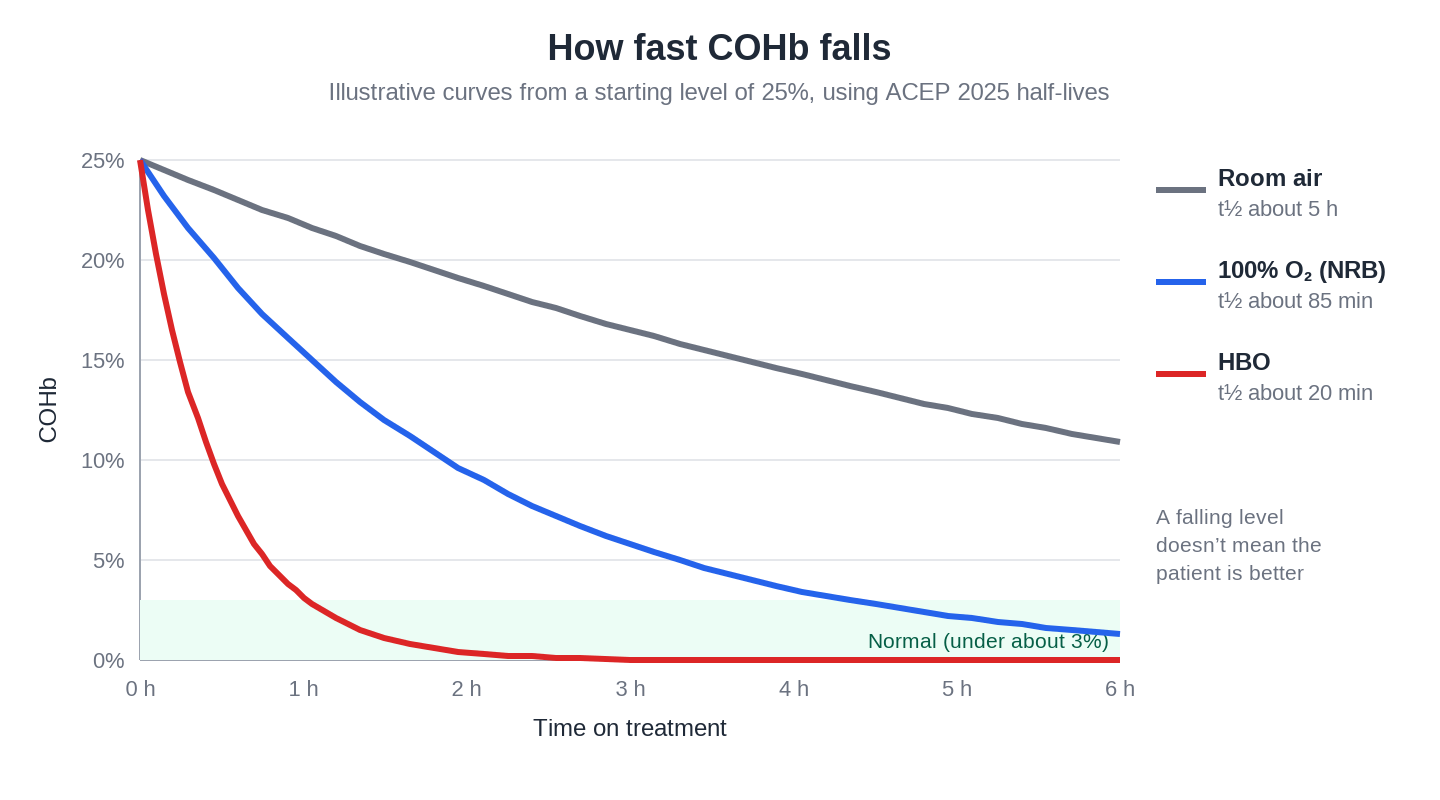
Normal COHb is under 2% in nonsmokers; smokers usually run under 10%, heavy smokers occasionally higher. A common diagnostic cutoff (CorePendium; Lieu 2025) is over 5% in nonsmokers and over 10% in smokers, and each daily pack adds roughly 2.5–5%, depending on the source. A level isn’t a severity score: it falls with time and oxygen even while the patient stays sick.
Pathophysiology
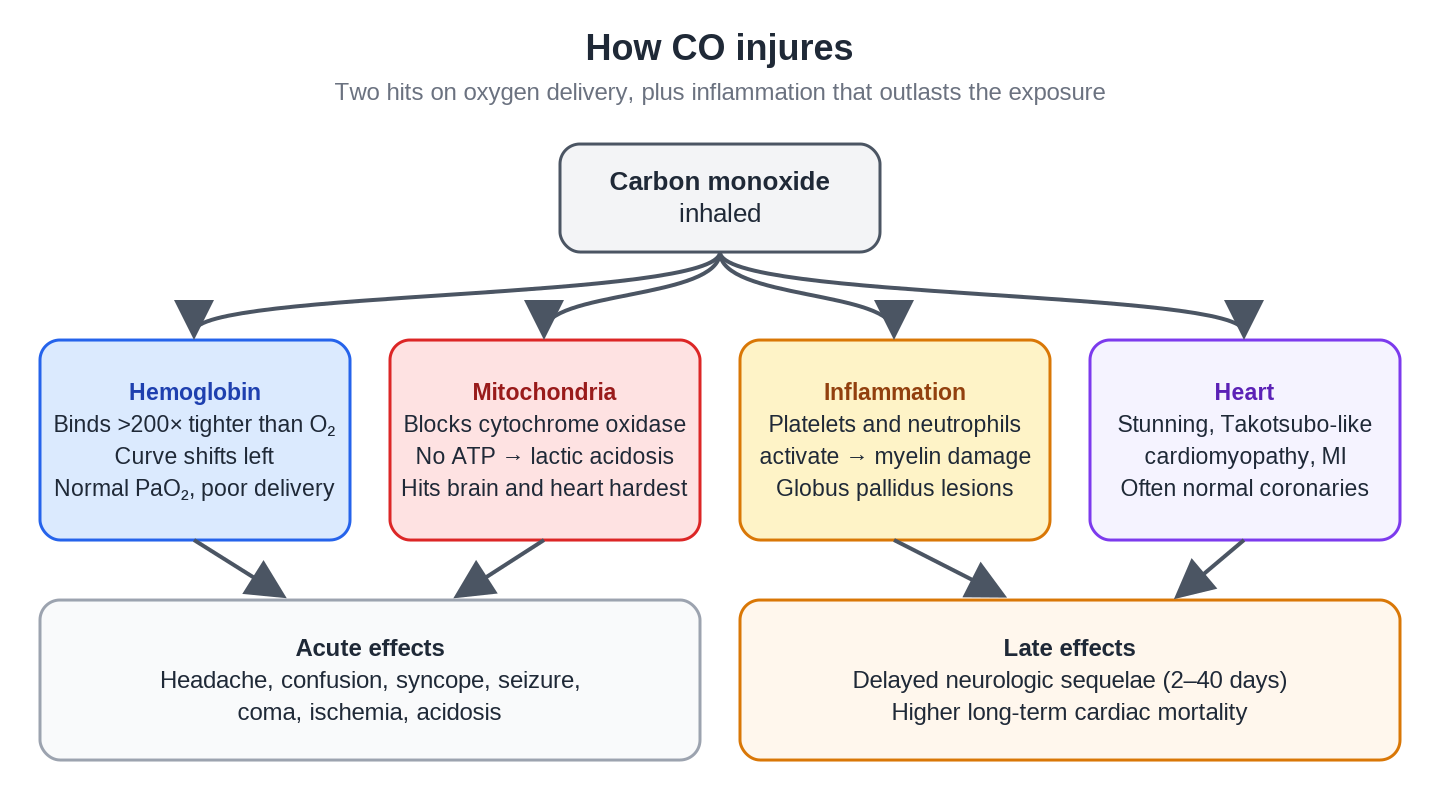
- Hemoglobin: CO binds hemoglobin over 200 times more tightly than oxygen and shifts the dissociation curve left, so tissues get less oxygen even at a normal PaO2.
- Mitochondria: CO also blocks cytochrome oxidase, so cells can’t make ATP. That causes lactic acidosis and hits the brain and heart hardest.
- Inflammation: CO activates platelets and neutrophils, which damage myelin. This is the likely driver of delayed neurologic problems and the globus pallidus lesions seen on imaging.
- Heart: myocardial stunning, Takotsubo-like cardiomyopathy and MI can occur, often with normal coronaries.
- Fetus: fetal COHb rises later, peaks higher and clears more slowly than the mother’s, so the fetus is at risk at lower maternal levels.
Recognition and Diagnosis
History
- The great mimic: headache, dizziness and nausea in winter. Flu is the most common misdiagnosis. In a small 1980s series, 24% of winter ED patients with flu-like symptoms had a COHb of 10% or more (Dolan 1987). A 2023 UK study found suspected exposure in only 0.62% of 4,175 symptomatic ED patients (Jarman 2023), so yield depends on who you test.
- Clues: others at home sick too (including pets), symptoms that improve away from home, a gas heater, generator or recent power outage, and no fever.
- Ask about the pets: small animals and children get sick first, so a sick or dead pet should raise concern.
- Accidental or intentional? Consider settling this early, using EMS, family and the chart for collateral.
- Less obvious: syncope, seizure, new confusion, chest pain or MI, unexplained lactic acidosis, or coma. Consider CO in all of these.
- Check the neighbors too: CO can seep through walls into the next apartment, so “we don’t burn anything” doesn’t rule it out.
- Chronic exposure: poor concentration, memory loss or personality change, usually from a work source.
Exam
- Findings range from normal to coma. Consider a careful neuro exam, including gait and cerebellar testing.
- Cherry-red skin is rare in living patients. Don’t wait for it.
- Pulled from a fire and comatose: assume CO, even without burns.
The pulse ox can look normal. Standard pulse oximetry reads COHb as oxyhemoglobin, so a 99% reading doesn’t rule out CO. Send a co-oximetry level.
Testing
Test | Notes |
COHb by co-oximetry | The test of choice. Venous is fine; it correlates closely with arterial (Touger 1995). Often needs its own order: many point-of-care gas analyzers, like the i-STAT, don’t measure it. Interpret it with time since exposure and any oxygen given: the level is often normal by arrival after time away from the source and prehospital oxygen. Smokers usually run under 10%; heavy smokers occasionally higher. Hemolysis, including sickle cell disease, can raise COHb through endogenous CO production |
Pulse CO-oximetry (SpCO) | Can be off by several points, with false positives and false negatives; not reliable to rule CO out. Accuracy is worse when SpO2 is under 85%, and ACEP (reaffirmed in 2025) and CorePendium advise against using it to screen, diagnose or exclude CO in the ED or prehospital setting. A 2026 prospective study found it read high with wide scatter, worse after HBO (Lee 2026). CDC guidance still lists fingertip pulse CO-oximetry as an available tool |
Lactate, anion gap | Elevated in more severe cases. In fire victims, a high lactate suggests cyanide too |
ECG, troponin | CorePendium suggests an ECG in all adults with suspected CO; troponin for chest pain, abnormal ECG, dysrhythmia, cardiac disease or older age. Myocardial injury occurs in 20–40% of moderate to severe cases and roughly doubles long-term mortality. Troponin can rise with normal coronaries and normalizes within a median of 65 h, but 69% of patients with elevated troponin had late gadolinium enhancement on cardiac MRI (Cho 2024). A normal repeat troponin doesn’t mean the heart is unscathed; consider bedside echo |
Pregnancy test | In anyone who could be pregnant; it lowers the threshold for hyperbaric oxygen |
Glucose, CK, chemistry | Point-of-care glucose for any altered patient. CK and renal function if found down, for rhabdomyolysis. If intentional, consider acetaminophen, salicylate and ethanol levels |
Chest X-ray | For dyspnea, hypoxia or signs of pulmonary edema |
CT or MRI head | Mostly to look for other causes. Bilateral globus pallidus lesions are the classic CO finding |
Hydroxocobalamin given for cyanide interferes with co-oximetry, and the direction depends on the analyzer: some read COHb falsely low, others falsely high, and some are barely affected. Draw COHb before giving it when that won’t delay the antidote, and tell the lab it was given.
Treatment
First Steps
- 100% oxygen right away by non-rebreather, or through the ventilator if intubated, as soon as CO is suspected. High-flow nasal cannula at 100% and high flow, a nasal cannula under the non-rebreather, or CPAP may deliver more oxygen.
- Usual resuscitation: airway, breathing, circulation. Consider early intubation for coma or airway burns.
- Smoke inhalation: consider cyanide if the lactate is high or the patient is hypotensive or in arrest. Two lactate triggers are quoted: 8 mmol/L or higher (expert panel, Milton-Jones 2023) and above 10 mmol/L (original smoke-inhalation cohort, Baud 1991).
- Avoid nitrites in the cyanide kit for CO patients: the methemoglobin they create further cuts oxygen delivery. Hydroxocobalamin is preferred and is adequate alone.
- Consider continuous monitoring with telemetry and capnography in severe cases, whatever the pulse ox says.
- Consider a cardiac monitor and ECG for anyone more than mildly symptomatic.
- Severe cases: consider avoiding hypotension and fever, since a second hit to the brain may worsen long-term injury. Consider serial neurologic exams to track progress and watch for cerebral edema.
Mild Cases (No High-Risk Features)
- Headache, dizziness or nausea only: continue 100% oxygen until symptoms resolve and COHb is normal, under about 3%.
- CDC advises oxygen until symptom-free, usually about 4–5 hours; CorePendium uses 4–6 hours. The traditional 6 hours has never been validated. Methylene chloride exposures may need 8 hours or more.
When to Consider Hyperbaric Oxygen (HBO)
HBO is controversial (see The Evidence below). These are the features most centers use to consider a referral:
Neurologic | Other |
Loss of consciousness or syncope | COHb 25% or higher |
Altered mental status or confusion | Pregnancy with COHb 15% or higher, or fetal distress |
Seizure or coma | Myocardial ischemia or dysrhythmia |
Focal deficit or abnormal cerebellar exam | Severe metabolic acidosis (such as pH under 7.1) or hypotension |
- Consider calling your regional hyperbaric center or poison control early; travel time matters.
- Timing: any benefit is likely greatest early, ideally within about 6 hours, and a long transfer may cancel it out. Only a small share of the 700-plus US chambers take high-acuity patients, and transfers over 50 miles are common (ACEP 2025).
- In a propensity-matched cohort of 2,034 admitted patients, HBO didn’t change mortality but modestly improved mental status and function at discharge, NNT about 41 (cited in ACEP 2025).
- Age 36 or older and exposure of 24 hours or more are separate risk factors for delayed sequelae; some centers weigh them when considering HBO.
- Chambers are cramped and hard to resuscitate in, so many centers prefer to stabilize unstable patients first.
- Factors against HBO: rapid improvement on normobaric oxygen, mild symptoms with no high-risk features, long delays to a chamber, or instability that makes transport unsafe.
- Side effects: middle ear barotrauma is most common, about 4% of treatments in a large series, and under 2% bad enough to interrupt one. Altered mental status raises the risk. Oxygen-toxicity seizures are rare (roughly 1–6 per 10,000 treatments) and stop when oxygen is removed.
Question | Key study | What they found | Takeaway |
Does HBO prevent brain injury? | Double-blind RCT, n = 152, three HBO sessions within 24 hours, the first at 3 ATA, vs normobaric oxygen (Weaver 2002) | Cognitive sequelae at 6 weeks: 25% vs 46%, so about 5–6 treated per case prevented. At 12 months, 18% vs 33%. Critics note it stopped early, the groups differed at baseline (cerebellar dysfunction 4% in the HBO group vs 15% in the normobaric group; the result stayed significant after adjustment, P = 0.03), and the endpoint changed from the original plan. The normobaric group also had a longer mean exposure (22 vs 13 hours). Follow-up was 97% | The strongest positive trial |
Then why the debate? | RCT, n = 191 (Scheinkestel 1999) | No benefit from HBO, and HBO patients did worse on a learning test. But 69% were suicide attempts, HBO started about 7 h (7.1 h) after exposure ended, and only 46% were followed up. HBO was given at 2.8 ATA, patients arriving together were cluster-randomized, and both arms received continuous high-flow oxygen for 3 days, which is not standard practice | Negative, but heavily criticized |
Lower pressure? | RCTs (Raphael 1989; Annane 2011) | The two French trials used 2.0 ATA and found no benefit, but they randomized only less severe patients to HBO vs normobaric oxygen. In comatose patients, two HBO sessions did worse than one (complete recovery 47% vs 68%). Scheinkestel used 2.8 ATA and was also negative, so pressure alone doesn’t explain the split. The positive trials used 2.8 ATA (Thom 1995) and 3.0 ATA (Weaver 2002) | Pressure, timing and severity may all matter |
All the trials together? | Cochrane review, 6 RCTs (Buckley 2011) | 2 positive, 4 negative, all with design flaws. 1,335 patients analyzed; sequelae at 4–6 weeks in 29% with HBO vs 34% with normobaric oxygen. Pooled odds of neurologic deficits: OR 0.78 (95% CI 0.54–1.12), not significant | Still debated |
What do guidelines say? | ACEP clinical policy (2025); UHMS, ECHM; CDC (2026) | ACEP (2025): Level C only. Selected symptomatic patients may benefit, depending on severity and access; benefit is likely modest, mainly memory. UHMS and ECHM recommend HBO for symptomatic patients and in pregnancy. CDC (2026) lists COHb above 25–30%, cardiac involvement, severe acidosis, loss of consciousness and neuro deficits, and calls HBO the treatment of choice in pregnancy | Societies disagree; consider local expert input |
Does the heart matter later? | Cohort, moderate to severe CO (Henry 2006) | 230 patients; 37% had myocardial injury. Over a median 7.6 years, 24% died overall: 38% of those with myocardial injury vs 15% without. The cohort died at 3 times the expected rate | Consider troponin, bedside echo and cardiac follow-u |
Special Situations
- Pregnancy: consider a lower threshold for HBO, at about 15–20% COHb, because the fetus is more vulnerable. Some suggest continuing high-flow oxygen for about 24 hours while fetal well-being is checked. Another approach, if HBO isn’t given, is to run normobaric oxygen about 5 times longer than it takes to get the mother under 5%.
- Fetal COHb rises later, peaks higher and clears slower, so it can’t be inferred from the mother’s level. Thresholds vary widely: one European guideline (ECHM) gives HBO to every exposed pregnant patient, while others use any maternal symptoms or COHb over 5% (over 10% in smokers). HBO appears safe in pregnancy: 32 pregnant patients treated at 2.4 ATA had no maternal or fetal harm (Arslan 2021). Consider shared decision-making and an OB consult in the ED.
- Children: may be more susceptible, and nausea and vomiting are often the main symptoms. Their COHb falls faster after removal, and slow blood draws can lower it further, so a normal level may mislead; lactate may track severity better. HBO has been used safely, but a benefit in children hasn’t been shown. For severe instability, consider ECMO early.
- High-flow nasal cannula at 100% may be better tolerated than a mask. Adult HBO criteria are generally applied. In one European survey of children in hyperbaric chambers, anxiety was the most common problem (6.8%), with ear or sinus barotrauma in 2.4% and seizures in 0.9%.
- Infants exposed alongside sicker family members: infants may not show toxicity the same way, so some consider HBO for them when an older co-exposed patient is severely affected.
- Infants: neonatal data are limited, so consider expert consultation.
- Older adults and heart disease: even low levels (4–6%) can cause ischemia.
- Intentional exposure: consider coingestions and a psychiatric evaluation.
- Fire victims: for burn inhalation injury, an expert panel rated transfer for HBO outside a burns service as inappropriate (Milton-Jones 2023).
Disposition
Situation | Dispo |
Mild, symptoms resolved, COHb normal, safe home | Discharge may be reasonable once the fire department or utility has checked the home |
High-risk features | Consider HBO referral; stabilize first and meet EMTALA requirements before transfer |
Cardiac injury or ongoing symptoms | Admission is usually needed |
Pregnant with an elevated COHb, significant cardiac disease, or unreliable follow-up | Consider admission |
Intentional exposure | Psychiatric evaluation before discharge |
Treat the house, not just the patient. Consider asking who else lives there, including pets, and arranging for them to be checked. Notifying the fire department to test the home may prevent the next case.
Discharge advice to consider: a working CO detector, no generators or grills indoors, and furnace servicing. Return for new headache, confusion, memory or mood changes. Consider cognitive follow-up in 4–6 weeks.
Delayed Neurologic Sequelae
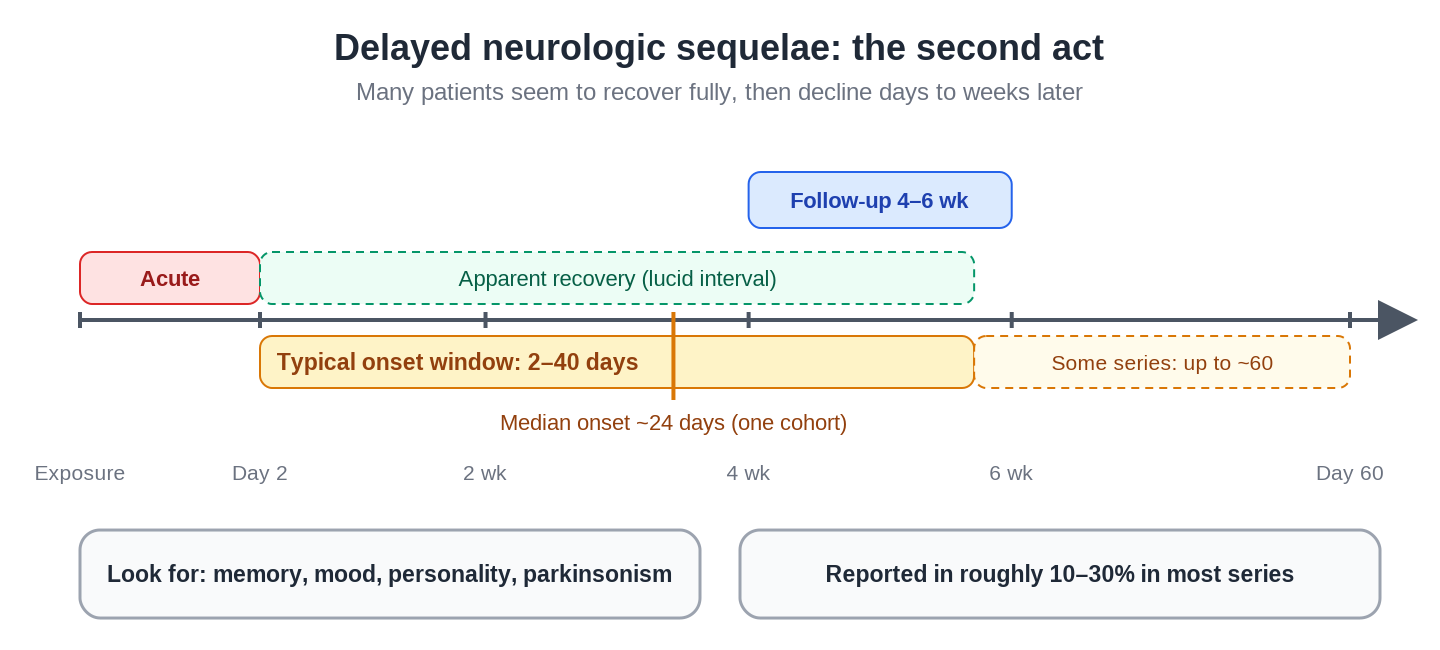
- Cognitive, memory, mood or movement problems appearing typically 2 to 40 days (some series report up to about 60 days) after exposure, often after an apparent full recovery.
- Reported in roughly 10–30% (range 2–40%, depending on the definition and how sick the cohort was); 19% and 11% in two recent cohorts of about 300 patients each (Han 2021; Zhang 2021).
- Risk factors (ACEP 2025): age 36 or older, COHb 25% or higher, exposure of 24 hours or more, loss of consciousness, low GCS or Mini-Mental score, and an abnormal head CT. GCS under 9 nearly triples the odds. Also reported: seizures, hypotension, leukocytosis, elevated CK and cerebellar signs.
- Can include dementia, parkinsonism, chorea, psychosis and peripheral neuropathy.
- Pulse CO-oximetry misses in both directions: in 1,578 unselected ED patients it read about 3% high on average, and 6.6% was the best screening cutoff (Roth 2011). Other studies found it read low; pooled sensitivity was only 65% at a 10% cutoff.
- Blood keeps: COHb samples stay accurate in sealed heparinized tubes for 28 days with or without refrigeration; samples left open to air lose CO (Hampson 2008). Handy for postmortem and legal cases.
- Deaths are falling, slowly: from 1,253 in 2015 to 1,067 in 2021, with cleaner car exhaust getting much of the credit. In 2021, accidental deaths outnumbered intentional ones for the first time (Cho 2024).
- Kids in pickup truck beds: 20 of 68 children treated for CO at one center had been riding in the back, most under a closed canopy (Hampson 1992).
- The FOAMed split: IBCC calls the HBO evidence unimpressive and leans against routine transfer; REBEL EM and Core EM lean on Weaver and favor HBO for severe cases. LITFL lands in the middle: not routine, but a subgroup may benefit.
TL;DR
Topic | Bottom line |
Suspect | Winter headache or “flu” without fever, others sick at home: consider CO |
Test | Co-oximetry COHb (venous is fine). A normal pulse ox doesn’t rule it out |
Treat | 100% oxygen right away; consider cyanide in fire victims |
HBO | Consider for syncope, altered mental status, seizure, ischemia, COHb 25% or higher, or pregnancy at 15% or higher. Benefit is still debated |
Dispo | Mild cases may go home once the home is safe. Consider cognitive follow-up in 4–6 weeks |
Sources
- Maloney GE. Carbon monoxide. In: Tintinalli JE, et al., eds. Tintinalli’s Emergency Medicine: A Comprehensive Study Guide. 9th ed. McGraw-Hill; 2020: Ch. 222, pp. 1414–1417.
- Carbon monoxide; Hyperbaric oxygen (Antidotes in Depth A40). In: Nelson LS, Howland MA, Lewin NA, et al., eds. Goldfrank’s Toxicologic Emergencies. 11th ed. McGraw-Hill; 2019: Ch. 122.
- Weaver LK, Hopkins RO, Chan KJ, et al. Hyperbaric oxygen for acute carbon monoxide poisoning. N Engl J Med. 2002;347(14):1057-1067. doi:10.1056/NEJMoa013121
- Scheinkestel CD, Bailey M, Myles PS, et al. Hyperbaric or normobaric oxygen for acute carbon monoxide poisoning: a randomised controlled clinical trial. Med J Aust. 1999;170(5):203-210.
- Annane D, Chadda K, Gajdos P, et al. Hyperbaric oxygen therapy for acute domestic carbon monoxide poisoning: two randomized controlled trials. Intensive Care Med. 2011;37(3):486-492.
- Raphael JC, Elkharrat D, Jars-Guincestre MC, et al. Trial of normobaric and hyperbaric oxygen for acute carbon monoxide intoxication. Lancet. 1989;2(8660):414-419.
- Buckley NA, Juurlink DN, Isbister G, Bennett MH, Lavonas EJ. Hyperbaric oxygen for carbon monoxide poisoning. Cochrane Database Syst Rev. 2011;(4):CD002041.
- Shih RD, Tomaszewski CA, Kaji A, et al. American College of Emergency Physicians clinical policy: critical issues in the evaluation and management of adult patients presenting to the emergency department with acute carbon monoxide poisoning. Ann Emerg Med. 2025. (Updates Wolf SJ, et al. Ann Emerg Med. 2017;69(1):98-107.)
- Hampson NB, Piantadosi CA, Thom SR, Weaver LK. Practice recommendations in the diagnosis, management, and prevention of carbon monoxide poisoning. Am J Respir Crit Care Med. 2012;186(11):1095-1101.
- Henry CR, Satran D, Lindgren B, et al. Myocardial injury and long-term mortality following moderate to severe carbon monoxide poisoning. JAMA. 2006;295(4):398-402.
- Farkas J. Carbon monoxide poisoning. Internet Book of Critical Care (IBCC), EMCrit. 2025.
- LITFL. Hyperbaric oxygen for carbon monoxide poisoning. 2019.
- Pediatric EM Morsels. Carbon Monoxide Poisoning in Children. 2018.
- REBEL EM. REBEL Core Cast 114.0: Carbon Monoxide Toxicity. 2023.
- Delbianco JD, Amaducci A. Carbon Monoxide Poisoning. CorePendium, EM:RAP. Updated January 30, 2026.
- Cho DH, Thom SR, Son JW, Ko SM, Cha YS. Practical recommendations for the evaluation and management of cardiac injury due to carbon monoxide poisoning. JACC Heart Fail. 2024;12(8):1343-1352. doi:10.1016/j.jchf.2024.01.001
- Lieu K, Smollin CG, LeSaint KT. What is carbon monoxide poisoning? JAMA. 2025;333(12):1098. doi:10.1001/jama.2025.1384
- Shin M, Bronstein AC, Glidden E, et al. Morbidity and mortality of unintentional carbon monoxide poisoning: United States 2005 to 2018. Ann Emerg Med. 2023;81(3):309-317. doi:10.1016/j.annemergmed.2022.10.011
- Centers for Disease Control and Prevention. Clinical guidance for carbon monoxide poisoning following disasters and severe weather. 2026.
- Pace R, Bon Homme M, Hoffman RS, Lugassy D. Effects of hydroxocobalamin on carboxyhemoglobin measured under physiologic and pathologic conditions. Clin Toxicol (Phila). 2014;52(7):647-650. doi:10.3109/15563650.2014.939659
- Lee J, Mukai D, Kreuter K, et al. Potential interference by hydroxocobalamin on cooximetry hemoglobin measurements during cyanide and smoke inhalation treatments. Ann Emerg Med. 2007;49(6):802-805. doi:10.1016/j.annemergmed.2006.11.016
- Carlsson et al. Hydroxocobalamin interference with blood gas analyzers. Scand J Clin Lab Invest. 2011.
- Milton-Jones H, Soussi S, Davies R, et al. An international RAND/UCLA expert panel to determine the optimal diagnosis and management of burn inhalation injury. Crit Care. 2023;27(1):459. doi:10.1186/s13054-023-04718-w
- Baud FJ, Barriot P, Toffis V, et al. Elevated blood cyanide concentrations in victims of smoke inhalation. N Engl J Med. 1991;325(25):1761-1766. doi:10.1056/NEJM199112193252502
- Baud FJ, Haidar MK, Jouffroy R, et al. Determinants of lactic acidosis in acute cyanide poisonings. Crit Care Med. 2018;46(6):e523-e529. doi:10.1097/CCM.0000000000003075
- Cao D, Arens AM, Chow SL, et al. Part 10: Adult and pediatric special circumstances of resuscitation: 2025 American Heart Association Guidelines for Cardiopulmonary Resuscitation and Emergency Cardiovascular Care. Circulation. 2025;152(16 suppl 2):S578-S672. doi:10.1161/CIR.0000000000001380
- Weaver LK. Carbon monoxide poisoning. N Engl J Med. 2009;360(12):1217-1225. doi:10.1056/NEJMcp0808891
- Thom SR. Hyperbaric-oxygen therapy for acute carbon monoxide poisoning. N Engl J Med. 2002;347(14):1105-1106. doi:10.1056/NEJMe020103
- Piantadosi CA. Carbon monoxide poisoning. N Engl J Med. 2002;347(14):1054-1055. doi:10.1056/NEJMp020104
- Thom SR, Taber RL, Mendiguren II, et al. Delayed neuropsychologic sequelae after carbon monoxide poisoning: prevention by treatment with hyperbaric oxygen. Ann Emerg Med. 1995;25(4):474-480.
- Del Moral-Barbudo B, Blancas R, Ballesteros-Ortega D, Quintana-Díaz M, Martínez-González Ó. Current and research therapies for the prevention and treatment of delayed neurological syndrome associated with carbon monoxide poisoning: a narrative review. Hum Exp Toxicol. 2020;39(6):765-772. doi:10.1177/0960327120901572
- Lee HY, Kim DK, Lee Y. Agreement and clinical utility of non-invasive SpCO versus arterial COHb in acute carbon monoxide poisoning: a prospective observational study. Sci Rep. 2026;16(1):20643. doi:10.1038/s41598-026-51424-y
- Moss P, Matthews N, McDonald R, Jarman H. Diagnosis of carbon monoxide exposure in clinical research and practice: a scoping review. PLoS One. 2025;20(2):e0300989. doi:10.1371/journal.pone.0300989
- Gei AF, Suarez VR, Vaught AJ, et al. Overdose, poisoning, and envenomation during pregnancy. In: Critical Care Obstetrics. Ch. 53.
- Arslan A. Hyperbaric oxygen therapy in carbon monoxide poisoning in pregnancy: maternal and fetal outcome. Am J Emerg Med. 2021;43:41-45. doi:10.1016/j.ajem.2021.01.007
- Gartenberg A, Dalla EE, Scoccimarro A, Halperin M. Carbon monoxide-induced myocardial injury: mechanisms, structural remodeling, and clinical implications. Am J Emerg Med. 2026;107:71-76. doi:10.1016/j.ajem.2026.05.030
- Henretig FM, Kirk MA, McKay CA. Hazardous chemical emergencies and poisonings. N Engl J Med. 2019;380(17):1638-1655. doi:10.1056/NEJMra1504690
- Liao SC, Shao SC, Yang KJ, Yang CC. Real-world effectiveness of hyperbaric oxygen therapy for delayed neuropsychiatric sequelae after carbon monoxide poisoning. Sci Rep. 2021;11(1):19212. doi:10.1038/s41598-021-98539-y
- Wen T, Liang J, Wei Y, Lin W, Pan L. Analysis of prognosis of neurological sequelae in children with carbon monoxide poisoning. Sci Rep. 2024;14(1):29972. doi:10.1038/s41598-024-81634-1
- Lopez-Pascual A, Trayhurn P, Martínez JA, González-Muniesa P. Oxygen in metabolic dysfunction and its therapeutic relevance. Antioxid Redox Signal. 2021;35(8):642-687. doi:10.1089/ars.2019.7901
- Dolan MC, Haltom TL, Barrows GH, et al. Carboxyhemoglobin levels in patients with flu-like symptoms. Ann Emerg Med. 1987;16(7):782-786.
- Heckerling PS, et al. Occult carbon monoxide poisoning. Am J Med. 1988.
- Jarman H, et al. Carbon monoxide exposure in symptomatic emergency department patients. J Public Health. 2023.
- Roth D, Herkner H, Schreiber W, et al. Accuracy of noninvasive multiwave pulse oximetry compared with carboxyhemoglobin from blood gas analysis in unselected emergency department patients. Ann Emerg Med. 2011;58(1):74-79.
- Villalba N, et al. Pulse CO-oximetry in the emergency department. Respir Care. 2019.
- Ramponi G, et al. Diagnostic accuracy of pulse CO-oximetry: a meta-analysis. Front Med. 2024.
- Han S, et al. Delayed neurologic sequelae after carbon monoxide poisoning: a prospective cohort. Neurotoxicology. 2021.
- Zhang Y, et al. Delayed neurologic sequelae after carbon monoxide poisoning: a multicenter cohort. Am J Emerg Med. 2021.
- Liu, et al. Delayed neurologic sequelae after carbon monoxide poisoning. Sci Rep. 2024.
- Yoo, et al. Risk factors for delayed neurologic sequelae after carbon monoxide poisoning. Sci Rep. 2023.
- Levett DZH, et al. Cochrane Database Syst Rev. 2015 (HBO adverse effects).
- Lin, et al. Cochrane Database Syst Rev. 2023 (HBO adverse effects).
- Park, et al. Middle ear barotrauma during hyperbaric oxygen therapy. PLoS One. 2024.
- Lee, et al. Adverse events of hyperbaric oxygen therapy. J Clin Med. 2025.
- Touger M, Gallagher EJ, Tyrell J. Relationship between venous and arterial carboxyhemoglobin levels in patients with suspected carbon monoxide poisoning. Ann Emerg Med. 1995;25(4):481-483.
- Hampson NB. Stability of carboxyhemoglobin in stored and mailed blood samples. Am J Emerg Med. 2008.
- Chace DH, et al. Carboxyhemoglobin stability in stored blood. J Anal Toxicol. 1986.
- Hampson NB, Norkool DM. Carbon monoxide poisoning in children riding in the back of pickup trucks. JAMA. 1992;267(4):538-540.
- Bonfiglioli R, et al. Methylene chloride and carbon monoxide. Am J Ind Med. 2014.
- Chiew AL, Buckley NA. Carbon monoxide poisoning in the 21st century. Crit Care. 2014;18(2):221.
- Ernst A, Zibrak JD. Carbon monoxide poisoning. N Engl J Med. 1998;339(22):1603-1608.
Further reading (FOAMed)
- emDocs. CO Toxicity: A Potentially Elusive Diagnosis. 2017.
- Core EM. Hyperbaric oxygen for acute carbon monoxide poisoning. 2019.
- ALiEM. Carbon Monoxide Poisoning: Common Questions and Dilemmas. 2013.
- Core EM. Episode 207: Smoke Inhalation Injury. 2025.
- Don’t Forget the Bubbles. Carbon Monoxide Poisoning. 2014.
This post is educational and not medical advice.